

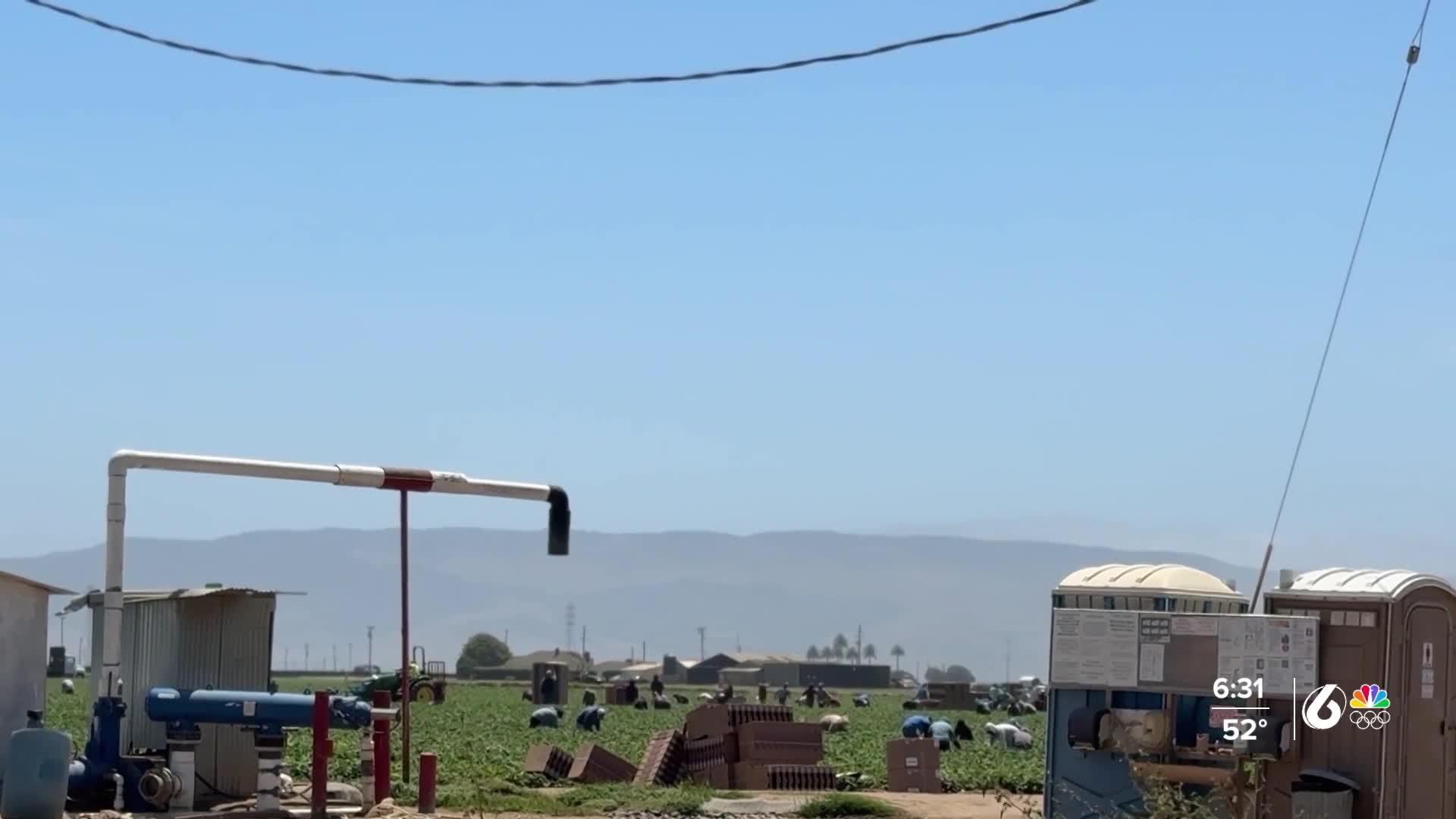



For some families, economic pressure can lead to impossible choices. As some immigrant parents stay home out of fear of deportation, their children, often born here, are stepping up as breadwinners, translators, and caretakers.
High school senior Yeudiel, who did not want to share his last name to protect his family, uses poetry to express the thoughts in his head and the feelings in his heart.
As we continue to work
We continue to see fear all around
We run, we hide, we pray, we cry
We always say the same line
How to make it back home safe?
The 18-year-old from Arroyo Grande was born in the United States, just like his two younger siblings, but his older brother and sister and their parents are undocumented immigrants. The possibility that they could be taken away at any time weighed heavily on his mind the entire time Yeudiel was growing up.
"I had a lot of family who had a close call and had been taken from ICE (U.S. Immigration and Customs Enforcement)," Yeudiel said. "They always have this fear in the back of their head where, what if today is the last day I'd be living here?"
Growing up, the assumption was always that, even as children, he and his brothers and sisters would work to support the family.
"So, I didn't really have a childhood. I had this mindset where I always gotta keep on working, providing help. I had this responsibility, which is why I grew up more than other kids during my age."
When he was seven years old, Yeudiel says he started working in groves with his parents, scaling up and down ladders, carrying heavy loads of oranges from one spot to another, and putting in almost 10 hours of work each day.
The goal was to fill as many boxes as possible.
He describes the experience as painfully brutal and now carries with him a constant reminder of that time.
"When you first start, there's always going to be pain. It's either by carrying heavy weights or just pretty much being on the ground for so long, and right now my back hurts," Yeudiel said. "It's always affecting my health in every way."
Yeudiel wears the scars from deep knife cuts on his palm, fingers, and fingertips. One of those cuts went all the way through to the bone.
"We cut an orange, we squeeze where we got the injury and that's what stops the bleeding, and then we continue like nothing happened," he said.
But not all scars on children in these types of situations are physical. Researchers and mental health workers say stories like Yeudiel's are part of a broader pattern they've seen for years.
Joanna Dreby is a professor of sociology at the University at Albany. She's spent more than two decades studying how immigration enforcement impacts families.
"One of the things we find is that enforcement actions cause major economic disruptions for children and their families. This leads to disruptions, economic instability, food insecurity, and housing, which means that kids are stepping up."
Even when children are not directly involved in an enforcement action, research shows that the fear of it can still shape their daily decisions and future.
KSBY News reporter Crystal Bermudez reached out to ICE repeatedly this year, including for this particular story, to find out how many parents with children under 18 have been deported from the Central Coast. However, she received no return calls or emails.
"One of the things we found is that these severe episodes really lead to later in life anxieties, pretty high levels of anxiety," Dreby said.
In addition to the threat of deportation, they understand that at any moment one member of the family, or all of them, could lose their jobs.
Federal law allows children as young as 12 to work on the same farm as a parent, as long as the work is not dangerous.
Yeudiel started working when he was seven, and somehow, for five years, he managed to elude supervisors in the field.
When he was young, Yeudiel says he ran and hid when supervisors made their rounds. As he got older, he got better at disguising himself.
"I had to put on a mask, a hat, pretty much everything just so, you know, they wouldn't see my face and see that I'm a kid."
This spillover effect on children, to take on parental roles, is a phenomenon Professor Dreby says has been documented in her research. Only now, the fear is more amplified.
"Children [are] actually taking on more paid roles in their families, which is very sad and disturbing, but also an extension, I think, given the fears and the experiences they're having," she said.
Now, with the recent surge in ICE activity, Yeudiel says his parents are afraid to go outside.
The high school senior still helps his family with everyday tasks, including going to the grocery store or picking up occasional shifts. Despite his fear of what could happen to his family, he continues to work and write poetry.
Dreby says that when communities step in to help, such as offering to serve as a translator and ease the burden on children, it makes a real difference for the kids who get caught in the middle.
