

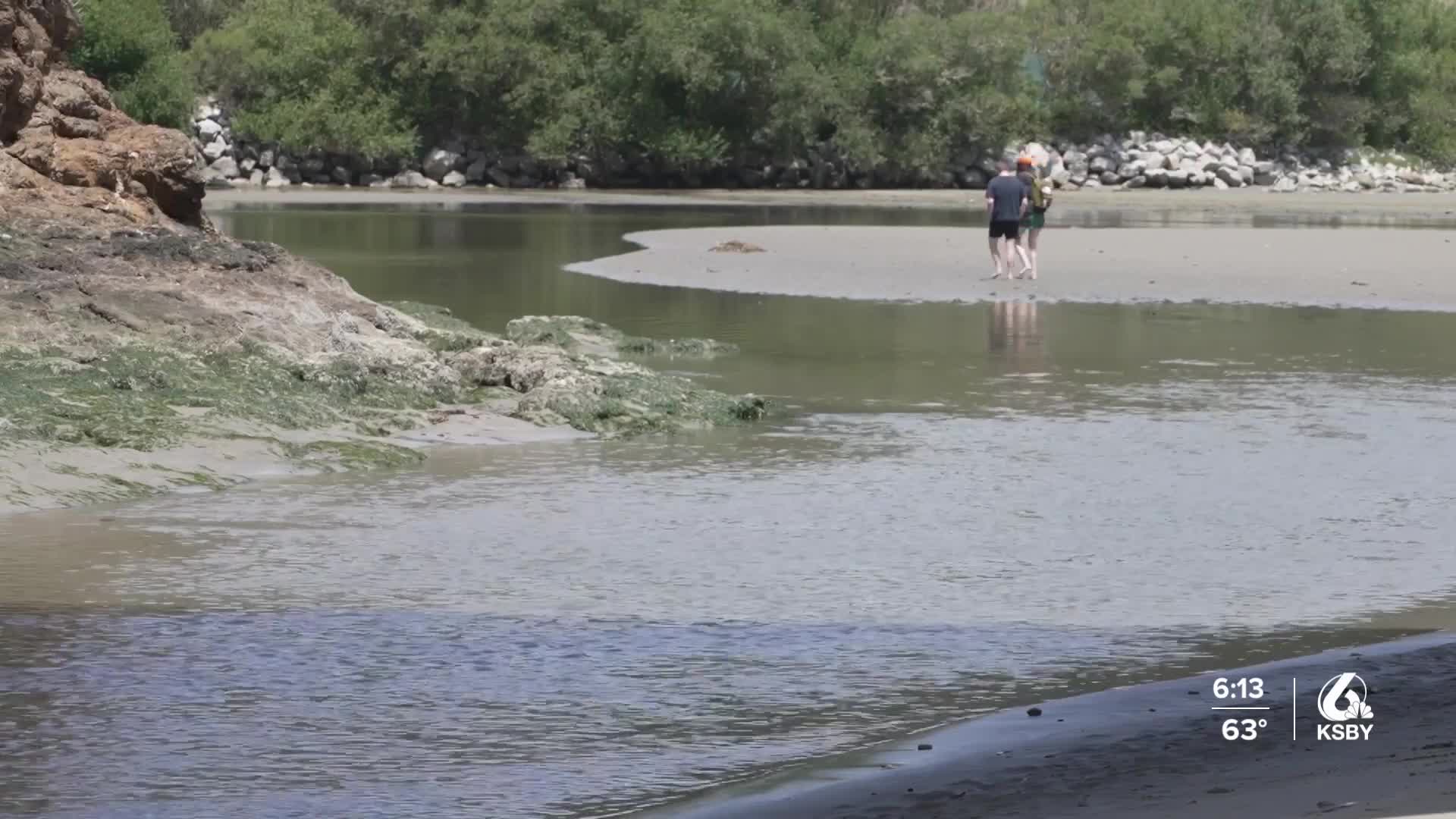



For the fourth year in a row, the area where San Luis Obispo Creek connects to the ocean in Avila Beach has been listed as one of the top beach bacteria hot spots in the country.
Rebecca Owsley came to Avila Beach on Monday to enjoy the scenery, but after hearing about the bacteria levels near the mouth of San Luis Obispo Creek, she’s changing where she’s setting up for the day.
“Well, we were just going to come down here and walk the beach, and my grandson wants to get in the water, but now we know not to go on that side," Owsley said.
The Surfrider Foundation, a national nonprofit, has found that this area has one of the highest beach bacteria levels out of 620 sampling sites in the country. It’s been in the top ten locations every year since 2022.
| Year | % of Enterococcus bacteria in water |
| 2022 | 34% |
| 2023 | 35% |
| 2024 | 38% |
| 2025 | 47% |
Jamie LeDuc is the manager of the Blue Water Task Force, a program of Surfrider that's dedicated to testing water levels for specific bacteria.
“Our goal of the Blue Water Task Force program is to help fill the gaps left by agency-run beach monitoring programs," LeDuc said. "There just isn't enough money funneling down for them to test every site all the time. So really, we're trying to help them to complement their program to help fill the gaps.”
San Luis Obispo Creek spans 18 miles, starting in the Santa Lucia mountains, passing through downtown San Luis Obispo and connecting in Avila Beach.
The Central Coast Water Board said in a statement that the current cause of the bacteria levels is still unknown, adding that, “There are many potential sources of bacteria in this area, including birds and bats, livestock, urban stormwater, human sources, leaking septic systems, or wastewater effluent.”
Peter Hague, San Luis Obispo County's Director of Environmental Health Services, said in an email that the county tests once a week during the summer, but does not investigate the causes of high bacteria where they collect samples.
The Central Coast Aquarium in Avila Beach hosts Surfrider’s testing equipment. Tatum Schneider at the aquarium said Surfrider focuses on Enterococcus bacteria, which indicates there is fecal pollution going into the ocean.
“That process is called Eutrophication," Schneider said. "So anything that's along that creek, whether it's human waste, trash, excess fertilizers, animal poop, human poop, whatever, that all goes into the ocean.”
She said the creek’s water could impact fish in the ocean by reducing their oxygen supply.
“The extra nutrients produce algae blooms," Schneider said. "Algal blooms consume a lot of oxygen.”
The bacteria can cause illness in humans, too. Hague said the county has posted permanent signs near the creek, but Owsley wishes there were more.
“Nobody wants to go in bacteria-filled water," Owsley said.
If you're heading out to the beach, you can check the Blue Water Task Force's findings or the County's Surf Safe SLO findings.
