

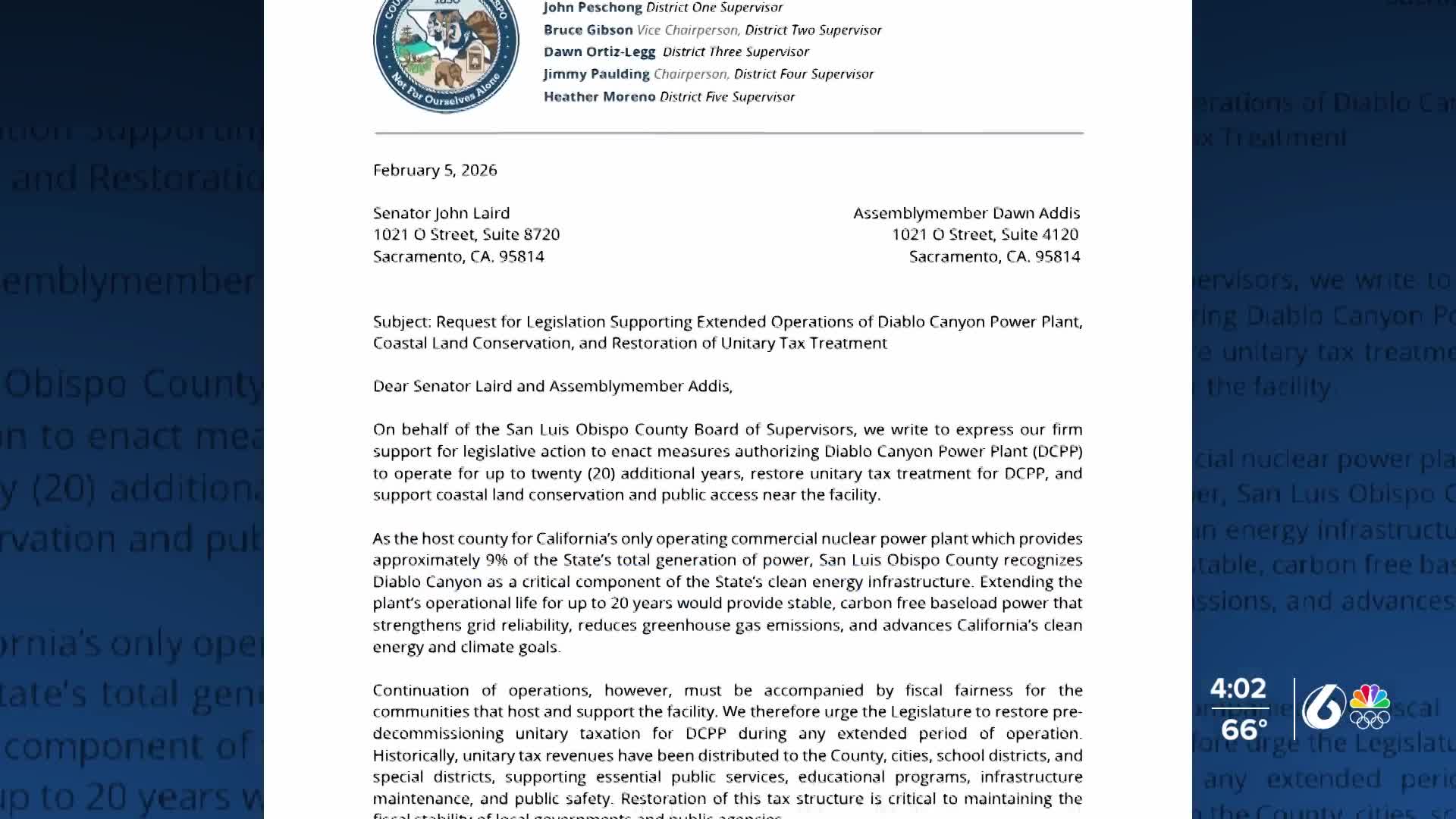


San Luis Obispo County has sent a letter to the state legislature supporting extended operations at Diablo Canyon Power Plant (DCPP).
Six San Luis Obispo County cities along with several community services districts, the Port San Luis Harbor District, County Air Pollution Control District and San Luis Coastal Unified School District agreed to sign onto the letter, which expresses support for “legislative action to enact measures authorizing Diablo Canyon Power Plant (DCPP) to operate for up to 20 additional years, restore unitary tax treatment for DCPP, and support coastal land conservation and public access near the facility.”
Back in December, the California Coastal Commission approved extended operations at DCPP, finding it “safe and environmentally sound to operate for another 20 years.”
It is approved to operate until 2030.
“So really what we’re talking about right now is what needs to happen between now and 2030 should Diablo get all the approvals necessary to extend its operation," Bruce Gibson, San Luis Obispo County District 2 Supervisor, previously told KSBY.
WATCH: SLO County seeking local city support for Diablo Canyon operation extension
The letter states that with the power plant providing approximately 9% of the State’s total generation of power, the county recognizes it as “a critical component of the State’s clean energy infrastructure” and that extending the plant’s operational life “would provide stable, carbon free baseload power that strengthens grid reliability, reduces greenhouse gas emissions, and advances California’s clean energy and climate goals.”
However, it also mentions that extended operations would need to come with fiscal fairness for communities that “host and support the facility.”
The county is asking Assemblymember Dawn Addis and Senator John Laird to restore pre-decommissioning unitary taxation or the plant during any length of extended operations.
“Historically, unitary tax revenues have been distributed to the County, cities, school districts, and special districts, supporting essential public services, educational programs, infrastructure maintenance, and public safety. Restoration of this tax structure is critical to maintaining the fiscal stability of local governments and public agencies. If restoring the pre-decommissioning unitary tax treatment proves infeasible, we request alternate financial mitigations to the County and local jurisdictions impacted by exemptions of taxable value on the DCPP during the period of extended operations established by the statutory prohibition against including operating costs in PG&E’s rate base,” the letter states, while also mentioning the county is supporting conversation and public access frameworks for landing surrounding the Avila Beach-area power plant.
The county is requesting the Legislature:
1. Support the Nuclear Regulatory Commission’s regulatory approval process and establish a state licensing pathway to authorize DCPP to operate for up to 20 additional years
2. Enact legislation restoring historic pre-decommissioning unitary tax treatment for Diablo Canyon Power Plant including land valuation for the duration of its extended operations or provide alternate equivalent financial mitigations
3. Support the California Coastal Commission’s land conservation and public access plan for lands surrounding Diablo Canyon, in coordination with appropriate regulatory and conservation agencies
The letter ends with the following: “Taken together, these actions represent a prudent and forward-looking policy framework that balances California’s clean energy needs with local fiscal health, environmental protection, and community interests. “Thank you for your attention to this important matter. We stand ready to work collaboratively with the Legislature to enact legislation that reflects these priorities and supports a sustainable and equitable future for San Luis Obispo County and the State of California.”
San Luis Obispo is the only city that has not signed onto the letter, with councilmembers instead deciding to send their own that will highlight three main points: public safety and preparedness, fiscal mitigation, and long-term planning and land conservation.
