

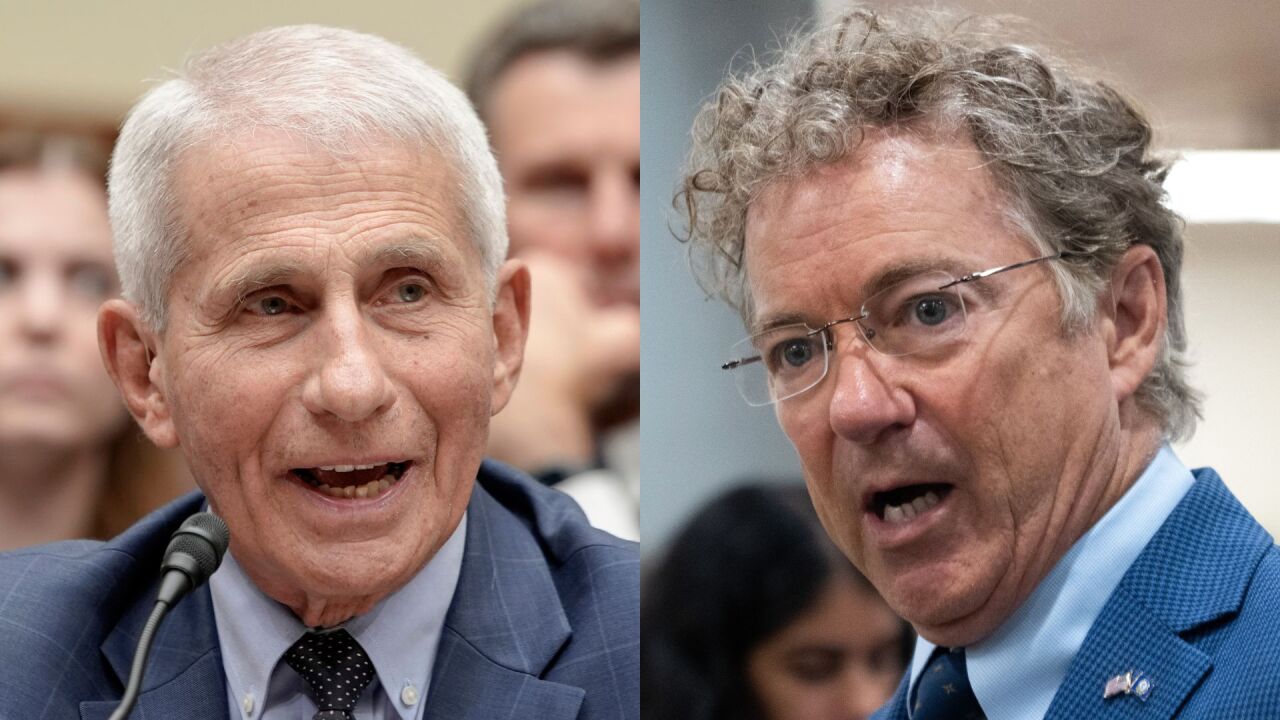

Even before the U.S. enacted a national shutdown due to the Covid-19 pandemic, Dr. Anthony Fauci pondered whether he might have testified before Congress more than any other official.
As the longtime face of the government’s infectious disease response, he was on Capitol Hill roughly 250 times over the course of his career to discuss threats such as the HIV/AIDS crisis and Ebola.
On Wednesday, the retired scientist will notch one more testimony, in what is expected to be a combative hearing before the Senate Homeland Security and Government Affairs Committee.
The appearance will mark the latest showdown with Sen. Rand Paul, the committee’s chairman, who has long sought to blame the Covid pandemic and shortcomings of the U.S. response on Fauci.
FROM THE ARCHIVES | Biden pardons Fauci, Milley to guard against potential 'revenge' by Trump
Fauci did not agree to turn up willingly. In June, Paul subpoenaed the 85-year-old former head of the National Institute of Allergy and Infectious Diseases for his appearance.
Internal correspondence shared with CNN shows that Fauci initially declined to appear voluntarily, citing his past clashes with Paul and the senator’s efforts to indict him.
“Your request that Dr. Fauci appear before the Committee arises within a context that cannot be ignored — the context of repeated public and absolutely baseless pronouncements by you, a sitting United States Senator, that Dr. Fauci should be prosecuted and jailed,” his lawyers wrote in a letter to Paul.
Ahead of the hearing, the committee released more than 1,100 pages of Fauci’s personal diary from 2019 to 2022. Health and Human Services secretary Robert F. Kennedy Jr. said Monday night on Fox News that he had recently handed the files over to Paul and Wisconsin GOP Sen. Ron Johnson after finding them on government servers following an eight-month search.
Neither HHS nor Paul’s committee alerted Fauci ahead of time that they had obtained his diary and that they planned to publish it in full, according to a person familiar with the matter.
The entries documented his frequent media appearances and growing fame, shining a light on his interactions with celebrities and dozens of members of the news media, including some CNN journalists.
The diary entries also narrate Fauci’s growing concerns about Covid-19, frustrations with the government response and conflicting relationships with both Trump and Biden administration officials.
Paul’s intense focus on discrediting Fauci has taken a toll on him, according to people familiar with the scientist. The long-running probe has forced Fauci to continue defending his actions well into retirement, while fueling further conspiracies theories about him and deepening distrust in the broader public health establishment.
The GOP fixation on Fauci also disrupted the careers of those closest to him; amid a Trump administration purge of federal health officials last year, Fauci’s wife was fired from her job at the National Institutes of Health, and at least three of his former longtime colleagues at the agency were reassigned.
“Nobody would want this. But I’ve known him for a very long time and we both use the phrase ‘Brooklyn strong’ quite a bit,” said Peter Staley, an AIDS activist and longtime friend of Fauci. “He’ll get through this,” he added. “He’s got all the facts on his side.”
Sen. Paul’s demands
Paul and Fauci have clashed repeatedly over the years about the origins of Covid-19, Fauci’s guidance on shutdowns and allegations that Fauci instructed NIAID staff on corresponding through private channels to avoid public records gained through Freedom of Information Act requests.
Since the early days of the pandemic, the senator has accused Fauci of greenlighting controversial research to make viruses more contagious and virulent, mostly as a means of better understanding their spread and how to treat them, known as gain-of-function research. Paul has alleged, without evidence, that NIAID-funded studies in Wuhan, China, used gain-of-function research and led to the coronavirus pandemic.
Fauci has repeatedly denied this both before the senator and in his diary entries.
FROM THE ARCHIVES | Dr. Anthony Fauci And Sen. Rand Paul Clash Over COVID-19 Origins
An analysis of viruses used in the Wuhan lab “clearly indicate(s) that it is molecularly impossible for the viruses under the auspices of the NIH grant to have been manipulated into or evolved into SARS-Cov-2,” he wrote in July 2021.
Paul has previously called for Fauci to be indicted for denying that the U.S. government funded of gain-of-function research in China, which Paul characterizes as a lie. Fauci has maintained that U.S.-funded studies did not meet the federal government’s definition of the restricted research.
This pressure from Paul and others led President Joe Biden to preemptively pardon Fauci during his last days in office, shielding Fauci from charges pertaining to any comments made in previous years.
Paul could attempt to renew calls for perjury charges based on the scientist’s remarks in the Wednesday hearing.
“If he lies during the hearing, that’s a new lie, and the pardon won’t cover that,” Paul said during his interview with Fox Business on July 15.
Yet despite new access to Fauci’s realtime thoughts throughout the pandemic, Paul and Johnson have both sought to manage expectations that the hearing will produce any major new developments.
“(I) don’t expect to get much out of him,” Johnson told Fox News last week. “But I’m going to try and lay out all the things that he did that were such a miserably failed response to Covid.”
Diary shows internal tensions, Fauci media strategy
Dozens of diary entries made public by the committee show Fauci’s growing concerns about the coronavirus threat and increasing internal conflicts about the government response.
Fauci referenced long calls and conversations with Trump in which they would discuss the Covid-19 response and the president’s messaging.
“Big surprise was at 10:35 PM tonight I got a phone call at home from President Trump who wanted to chat about the coronavirus situation in general,” he wrote on February 27 , 2020. He urged the president not to underplay the seriousness of the virus but noted that he did just that the next day.
In July 2020, he and other officials explained to the president in an Oval Office meeting that vaccines would not be ready before the presidential election in November.
“He accepted that the vaccine might not be ready before the election, but he was not happy about it. He kept pushing about when therapy would be ready,” Fauci wrote.
But fractures in their relationship were forming, as Fauci noted days later.
“The POTUS is playing a weird game of acting Okay with me in person and saying that our relationship is fine to the press and then retweeting stuff that attacks me. He is a very strange guy,” Fauci wrote on July 28, 2020.
In other entries, Fauci noted Trump nearly “begging” Fauci and other Coronavirus Task Force members to end shutdown measures and yelling at officials such as Dr. Deborah Birx, coordinator of the task force, that shutdowns were ruining the economy and his reelection efforts.
“Trump getting out of control in pushing to open up the country and get the economy back before election day. He is desparate (sic). This is all about re-election,” Fauci wrote in May 2020.
The diary also indicates that Fauci believed administration officials were blocking his media appearances, particularly when his message fell out of line with Trump’s narrative. Fauci and Trump denied early in the pandemic that the administration was limiting his media appearances, but by the summer, the tension had grown.
A Health and Human Services spokesperson at the time “told me that I am being kept off TV (even though they were leaning to approve requests) because of my comment about ‘false narrative’ concerning relying on deaths going down,” he wrote in July 2020.
In other entries, Fauci wrote about Trump’s illness with coronavirus and later Biden’s illness, discussions of booster vaccines and America’s “Covid fatigue.” The diary continued through late 2022, with Fauci mulling in some writing about when he would retire.
In early entries, Fauci made a few brief allusions to people who would years later join Trump’s second administration.
On October 7, 2020, he wrote that then-HHS Secretary Alex Azar met with White House advisor Scott Atlas and “his 3 stooges” who authored the Great Barrington Declaration, a call to end broad shutdown measures. One of those people was Dr. Jay Bhattacharya, now director of the National Institutes of Health.
On April 2, 2020, he fretted that now HHS secretary RFK Jr. was preparing to publish a book about him that “will almost certainly be slanderous.”
Fauci documents his boom in fame
The pandemic saw Fauci become a household name, and in his diaries, he regularly marveled at the “media frenzy” and noted with some amusement comics, memorabilia and art depicting him.
“For better or worse, I am becoming an international celebrity. Calls from all over the world,” he wrote in March 2020.
He seemed to revel in the celebrity connections bolstered by his position. In April 2020, reality star Kim Kardashian arranged a Zoom call for him to speak with nearly three dozen actors, singers and athletes, including Demi Lovato and Michael Jordan.
In December 2020, he noted that several celebrities appeared in a video compilation wishing him a happy birthday. “It was very moving,” he wrote.
Earlier that month, Fauci logged that he “received a call from Ethel and Kerry Kennedy explicitly inviting (me) up to Hyannisport for 4th of July weekend. They were so nice over the phone. They said that they loved and admired me and were so please that the Kennedy family could honor me.”
He appeared to monitor how his outreach with celebrities was received, noting in April 2021 that “95%” of comments on an Instagram Live with model and actress Tyra Banks were positive, but “some were really mean and vicious statements about me and Tyra.”
He added, “One person said that Tyra was sexy, but I was even more sexy than she was. She read it and put a big smile on her face and said that she agreed with that but then beautifully and gently shot this down by saying: ‘Dr. Fauci, that is true and my mother is in love with you.’”
At times, celebrities almost treated Fauci as a private physician and confidant. In February 2021, actress and singer Barbra Streisand called him to discuss the safety of mRNA vaccines after a shingles outbreak. They later discussed “life in general,” and Fauci explained the Amazon product Alexa to Streisand by instructing the virtual assistant to play her songs. By October, Streisand was asking about booster shots, and they joked about their mutual Brooklyn accents.
“It is always good to hear from her,” Fauci wrote.
The-CNN-Wire™ & © 2026 Cable News Network, Inc., a Warner Bros. Discovery Company. All rights reserved.
