

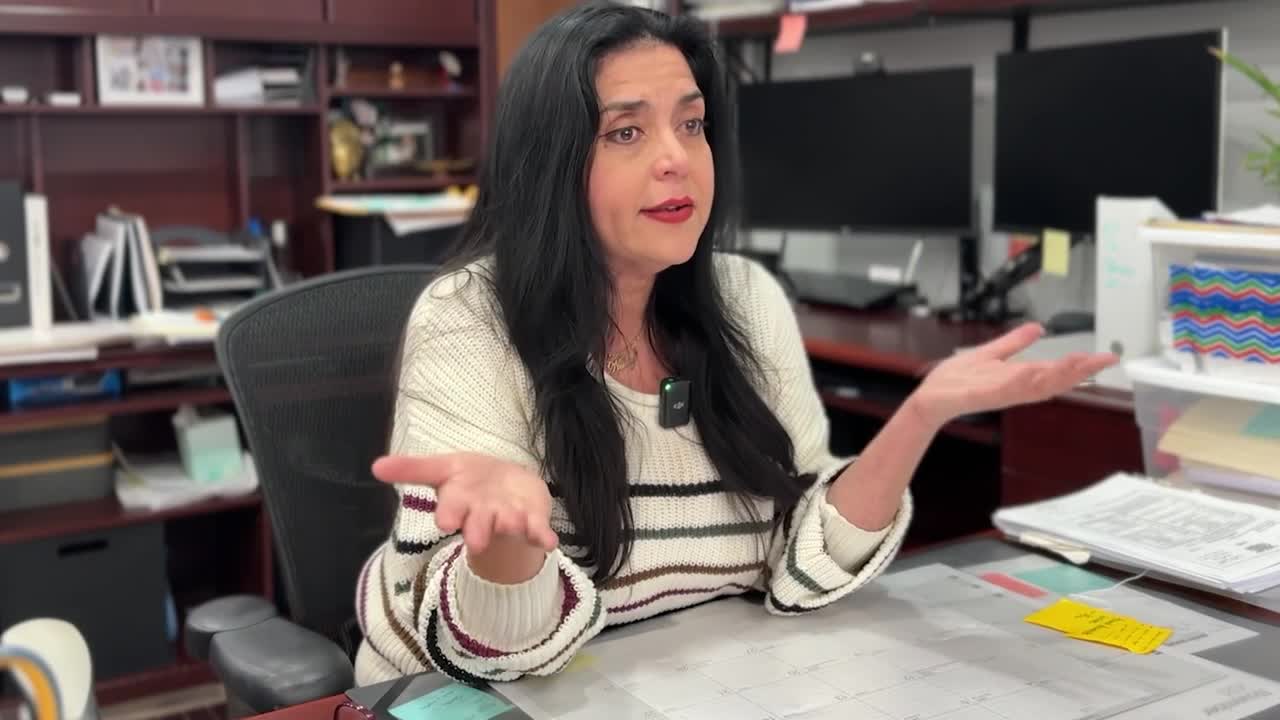


Nedry Aguilar struggled to hold back tears as she described life in Venezuela, a country she fled more than two decades ago and one she says still silences its people.
“En Venezuela la gente no es libre de expresarse,” Aguilar said.
In Venezuela, people are not free to express themselves.
Aguilar is a Venezuelan immigrant and now lives and works in Santa Maria.
She left Venezuela in October 2004 after what she describes as political persecution during the government of former President Hugo Chavez.
She said the recent arrest of Venezuelan President Nicolas Maduro brought a mix of relief, fear and uncertainty, especially for family members who remain in the country.
“Yo hoy tengo la libertad de poder hablar contigo,” Aguilar said. “Tú me estás entrevistando y soy libre.”
Today, I have the freedom to be able to speak with you. You are interviewing me, and I am free.
Aguilar said she never planned to live permanently in the United States.
“No era mi sueño vivir en los Estados Unidos,” she said. “Yo venía solo de visita.”
It was not my dream to live in the United States. I was only coming to visit.
At the time she left Venezuela, Aguilar said she was a lawyer working against corruption.
“Soy abogado y por cosas del destino dictaba cursos encontra de la corrupción en Venezuela,” she said.
I'm a lawyer and, by chance, I taught courses against corruption in Venezuela.
She said that work made her a target.
“Ellos me hicieron la vida imposible,” Aguilar said.
They made my life impossible.
Aguilar said she was removed from her position despite protections tied to her job.
“Me sacaron de mi cargo cuando mi cargo era un cargo de concurso,” she said.
They removed me from a position that I had earned through a competitive process.
She said her family was forced to flee, leaving behind businesses, education and stability.
“Tenía tiendas, tenía una carrera con dos maestrías y tuve que dejar todo, absolutamente todo,” Aguilar said.
I had shops, I had a career with two master’s degrees, and I had to leave everything, absolutely everything.
Her husband left first. She later followed with their two children, who were 12 and 13 years old at the time. Aguilar said she has not returned to Venezuela since leaving and believes doing so would be dangerous.
Now a grandmother, she said the risk feels even greater.
The arrest of Maduro triggered panic among Venezuelans inside and outside the country, Aguilar said. She described receiving a late-night phone call from relatives who reported explosions near La Guaira, where members of her family live.
“Tengo gente que está que ahorita, con una de las explosiones, su apartamento estaba casi enfrente de una de ellas, aterrorizada con todo lo que está sucediendo.”
I have people who, right now, with one of the explosions, their apartment was almost right in front of one of them. They’re terrified by everything that is happening.
She said Venezuelans abroad began calling each other, trying to understand what was happening.
When Aguilar learned Maduro had been captured, she said the emotions were complicated.
“Teníamos una alegría pensando de que salió el dictador,” she said. “Pero también teníamos miedo.”
We had a sense of joy thinking that the dictator had left, but we were also afraid.
She said fear remains because the political system she fled is still largely intact.
“Sacaron a Maduro,” Aguilar said. “Pero todavía están ellos allá."
They removed Maduro, but they’re still there.
She said relatives who remain in Venezuela depend on help from abroad.
“Dependen de que uno les ayude porque no hay comida,” Aguilar said.
They depend on people to help them because there’s no food.
She said even sending money is often not enough.
“Cien dólares no alcanzan para que coman,” she said.
One hundred dollars isn’t enough for them to eat.
Aguilar works as a clerk-bookkeeper at an immigration services office in Santa Maria, where she assists immigrant families navigating paperwork and legal processes. She said Venezuelans arriving in the United States today face uncertainty.
“La palabra que define el pensamiento de un Venezolano es incertidumbre,” Aguilar said.
The word that defines a Venezuelan’s mindset is "uncertainty.”
She said Venezuelans want peace and freedom.
To understand what Maduro’s arrest could mean economically and politically, national security expert Ron Bee pointed to oil, economics and migration.
Bee said Venezuela’s relationship with the United States shifted dramatically after Chávez came to power.
“Venezuela and the United States had a great relationship after 1958, until Hugo Chavez came into power, where he took over the reins as a socialist and decided that he was going to take over and nationalize the oil industry of Venezuela," Bee said.
He added that oil is central to understanding Venezuela’s global importance.
“Venezuela has 300 billion barrels of reserves,” Bee said. “That’s the most in the world.”
He said Venezuela once produced far more oil than it does today.
“They did produce about three million barrels a day,” Bee said. “They’ve only been using about 550,000 barrels a day.”
Bee said oil production under Chávez and Maduro largely bypassed the global marketplace.
“The oil that has been pumped thus far by first Hugo Chavez and then Nicolas Maduro was for the most part going to China and Cuba, not into the world marketplace,” Bee said.
He said oil also plays a role in how the arrest of Maduro could affect prices.
“When there’s a lot more oil in the global marketplace, the price comes down,” Bee said.
He cautioned that any impact would not be immediate.
“It’s going to take a lot of investment and rebuilding of the capacity before you will see the oil coming out of the ground,” Bee said.
He said the situation is closely watched by Venezuelan refugees.
“If you’re Venezuelan and a refugee in the United States, you’re probably very happy that Maduro’s gone,” Bee said. “But what are you going to go home to?”
He said the broader question remains unresolved.
“Now the big question is, what’s next?”
Bee also pointed to Venezuela’s political history.
“Venezuela has a history of democracy from 1958 until Hugo Chavez,” he said.
For Aguilar, the analysis is deeply personal.
She said Venezuelans everywhere are watching closely.
“Solamente un Venezolano puede entender porqué otro Venezolano celebra,” Aguilar said.
Only a Venezuelan can understand why another Venezuelan celebrates.
Despite decades away from her homeland, Aguilar said she still believes change is possible.
“Yo tengo la fe de que algún día mi país va a ser totalmente libre,” she said.
I have faith that one day my country will be completely free.
For now, she said, Venezuelans continue to wait and to speak when they can.
