

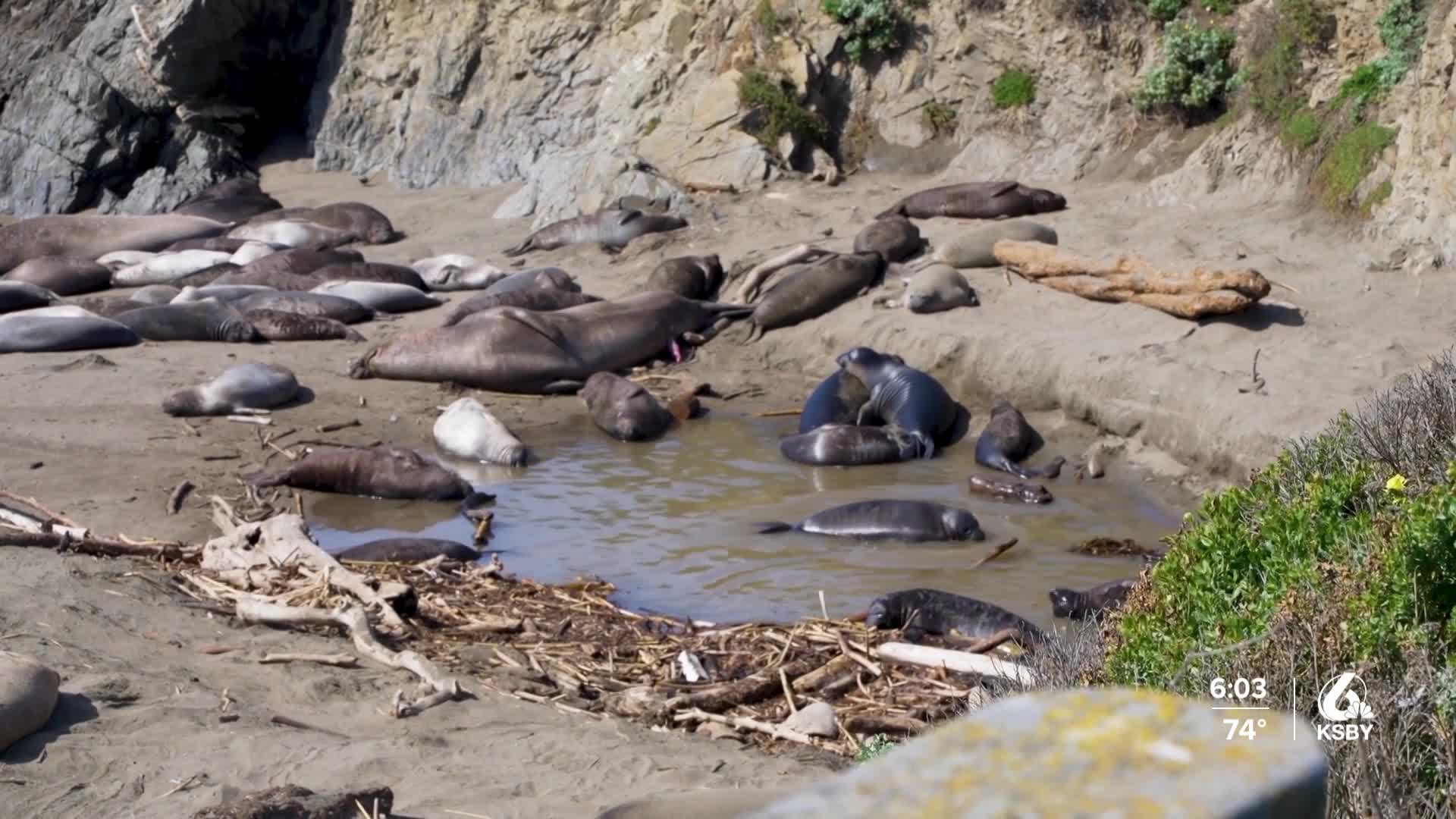


For the first time, avian flu has been found in California’s marine mammals, and wildlife officials are working to contain its spread.
Seven weaned elephant seal pups have tested positive for avian bird flu at Año Nuevo State Park in San Mateo County.
Christine Johnson’s lab tested the samples before sending them to the National Veterinary Laboratory to confirm the results.
“They were displaying respiratory and neurological disease signs, so specifically the neurological disease, which is pretty typical for HPAI avian influenza, was weakness and tremors and seizures,” said Johnson, Director of the Institute for Pandemic Insights at UC Davis.
She said the pups did not survive and no treatment could save them.
"There’s approximately 30 that might’ve been affected to date on the colony and samples are in progression through the various laboratories,” Johnson said.
In San Luis Obispo County, local organizations have been made aware of the outbreak.
“We’ve been in communication with our counterparts in Santa Cruz who are working in a unified command with NOAA and Fish and Wildlife and other agencies, and we’ll continue to gather that information and anything that’s relevant to us," said Dan Falat, California State Parks San Luis Obispo Coast District Superintendent.
Cal Poly professor Heather Liwanag earned her PHD at UC Santa Cruz and spent some time at the rookery where the flu was detected.
She is involved in monitoring the seals at Piedras Blancas near San Simeon and has been on the lookout for avian flu for the last few years.
“We saw the devastation that this did for the southern elephant seals in the southern hemisphere. We’ve been keeping an eye because the birds are the main vector for this pathogen and the birds do travel between hemispheres,” Liwanag said.
Liwanag said that what’s happening in San Mateo County seems like a localized outbreak, but her team is ready in case they’re asked to do some tests on asymptomatic seals on the Central Coast.
“If we are asked by the agencies to do that, then we would definitely help out with that. We’re not really equipped to do that ourselves so that would be in collaboration with The Marine Mammal Center,” Liwanag said.
The Marine Mammal Center told KSBY News that they have “temporarily suspended” responses to elephant seals and Pacific harbor seals out of caution.
As of Thursday, Feb. 26, no cases have been detected on the Central Coast.
