



UPDATE: 6 p.m.
In an email to KSBY, Gaea Powell issued the following statement:
I want to begin by thanking the jurors for their service, their attention throughout this trial, and the seriousness with which they approached an extraordinarily difficult responsibility.
I respect the jury's role. But I am deeply disappointed by today's verdict.
I have maintained from the beginning, and I maintain today, that I did not knowingly deceive anyone and did not act with fraudulent intent. I openly discussed my living circumstances, sought guidance from election officials concerning my eligibility to run for office, and believed I was acting lawfully.
I may have lost this battle.
But this is not the end of the legal fight.
I intend to pursue every appropriate post-trial remedy and to appeal this case. And just as importantly, another chapter is only beginning.
For more than two years, I have lived through an extraordinarily invasive government investigation and prosecution. My cell phones were seized and have not been returned. The government obtained extensive T-Mobile, Google, Facebook, Instagram, and Nextdoor data spanning years of my life. The investigation ultimately encompassed an extraordinary volume of private electronic information—not only mine, but information involving people who communicated with me, along with my private contacts and communications.
Yet one of the central questions I continue to ask is remarkably simple:
How did what began as a dispute over election eligibility become a multiple-felony criminal prosecution?
And how was this investigation actually conducted?
Those questions matter.
They matter because the Constitution does not cease to exist when the government decides to investigate someone.
The First Amendment matters.
The Fourth Amendment matters.
Due process and equal protection under the Fourteenth Amendment matter.
And 42 U.S.C. § 1983 exists for a reason: it provides a federal civil remedy when government officials, acting under color of state law, deprive a person of rights secured by the Constitution or federal law.
That is where my focus will now turn.
Representing myself in this criminal trial gave me an extraordinary opportunity to examine the discovery, investigative reports, witness interviews, electronic searches, chronology, and communications underlying this prosecution.
And I have questions that were not answered in this courtroom.
Why wasn't Nicholas Coughlin -- the primary investigator whose work was at the center of this investigation -- called by the prosecution to testify?
Why did this investigation move so rapidly into sweeping searches of my electronic life?
Why wasn't the City of Arroyo Grande election official -- an official the County Clerk-Recorder directed investigators on day one—interviewed before some of those invasive investigative steps were taken?
And what does the complete chronology of this investigation reveal?
There was evidence I wanted the jury to see and issues I wanted the jury to hear that the prosecution strongly objected to and that ultimately were restricted or excluded during this trial.
I believe that matters.
Why wouldn't the prosecution want the jury to hear the entire story?
The prosecution's objections, the evidence that was excluded or restricted, and the Court's rulings can now be examined through the appropriate legal processes.
I do not fault the jurors. They did not determine what evidence would ultimately be admitted or excluded. They were required to decide this case based upon the evidence they were permitted to hear and the legal instructions they were given.
They fulfilled their responsibility.
Now I will fulfill mine.
My focus turns elsewhere.
I may have lost this battle, but my fight to vindicate my constitutional rights is not over.
In many ways, it has just begun.
I intend to pursue my appeal.
And I intend to turn the same laser-like focus I brought to defending myself in this courtroom toward examining the actions taken under color of law that brought me here and, where supported by the evidence and the law, pursuing those constitutional claims in federal court under 42 U.S.C. § 1983 and other applicable federal law.
That fight will take place where it belongs: in court, through all of the evidence, documents, testimony, and the Constitution.
I am not intimidated by the size or power of the institutions involved.
Power is not proof.
Government officials are not above the Constitution.
And accountability does not end with a guilty verdict.
So today, I thank the jurors for their service.
I thank my husband, Michael, my friends, and all the people who have stood beside me throughout this ordeal.
And I want them to know something:
I will keep fighting.
Lawfully.
Publicly.
And relentlessly.
This battle may be over.
My appeal begins.
And the constitutional fight has just begun.
Thank you.
UPDATE: 3:20 p.m.
A jury has found Gaea Powell guilty on all nine counts related to allegations of voter registration fraud, filing a false declaration of candidacy and perjury.
Powell had the jury polled, and jurors confirmed their decisions. She faced the following charges:
- Voter Registration Fraud
- Perjury By Declaration
- Filing False Nomination Or Declaration Papers (2 counts)
- Failure To Provide Written Notification
- Fraudulent Voting (3 counts)
The former Arroyo Grande mayoral candidate and San Luis Obispo County clerk-recorder candidate is scheduled to be sentenced on Oct. 19.
Outside of the courtroom, Dan Dow, the District Attorney for the County of San Luis Obispo, spoke on a ninth count against Powell:
“Well, we've just been told that unfortunately the parties in court forgot to read the ninth count verdict. We've been told that it is as the other eight, it's guilty, so we understand the jury returned nine guilty verdicts. … Right now, as to count nine, the court will reconvene on Wednesday in order to address that issue with both the defendant and our prosecutor, and we'll have to wait until then, but my understanding is the jury has returned a verdict of guilty on each of the nine counts.
It's really up to the court at this point to determine the best way forward, so the court may require the jurors to come back to question them as to whether or not count nine is truly their verdict, or he may just address the parties and find another way to resolve that, that particular question.
I've been told that there were nine verdict forms representing nine counts and that all of those verdict forms indicated guilty. So, my assumption is that the last two pages may have stuck together and when they were being read, they just turned over two pages instead of one and no one, unfortunately, caught that error at the time that it happened … but we have full faith in the court to be able to handle this and come to the right resolution on Wednesday.”
Dow concluded, “With respect to the political climate in today's culture, we're a rather divided, you know -- community, state and nation, and yet today is a day I think that we should all be able to say our judicial system works when we do a thorough investigation, we present the information in court and a jury gets to decide. It's not about left, it's not about right -- it's about right and wrong, and that's what our prosecutor, Deputy DA Blumenthal said in his closing arguments.
No one of any party, no one of any status is above the law, and my office is committed to this mission … that includes public integrity, holding elected officials and/or public officials trying to become elected accountable under the law and so we're going to continue to do that.”
UPDATE: Monday, Sep 21, 2026 at 11:51 a.m.
Jurors begin their first full day of deliberations Monday in the case of Gaea Powell, a San Luis Obispo County woman accused of election fraud. After returning from morning recess, the jurors asked the bailiff to have the judge bring the court reporter into the deliberation room and read a transcript to them. Shortly thereafter, Judge Timothy Covello cleared the courtroom. He had previously been handling other cases in his courtroom as the jurors worked in their quarters. By 11:49 a.m., jurors took their lunch break and are scheduled to reconvene at 1:30 p.m.
Powell is accused of lying about where she lived when she previously ran for mayor of Arroyo Grande.
On Friday, she delivered her own closing arguments. KSBY Reporter Jessica Roe arrived in court at 9 a.m. as deliberations began nearby. She was in the courtroom as Powell told jurors they could not find her guilty beyond a reasonable doubt because prosecutors could not prove she intended to break the law. On Monday, Ms. Powell sat at a workstation in a hallway of the court, working on a computer.
On Monday, both the prosecution and defense were told to stay nearby and return to court promptly if the jury returns.
On several occasions during her arguments, Deputy District Attorney Ben Blumenthal objected to Powell's statements, with the judge sustaining the prosecutor's motions.
Powell ran in both 2022 and 2024. In 2026, she ran unsuccessfully for SLO Co. Clerk-Recorder.
Representing herself, Powell argued that the jury could not convict her because there is no way to prove "intent," a key issue in the case. Powell repeatedly said prosecutors could not prove her intent, as she claimed she did not knowingly do anything wrong.
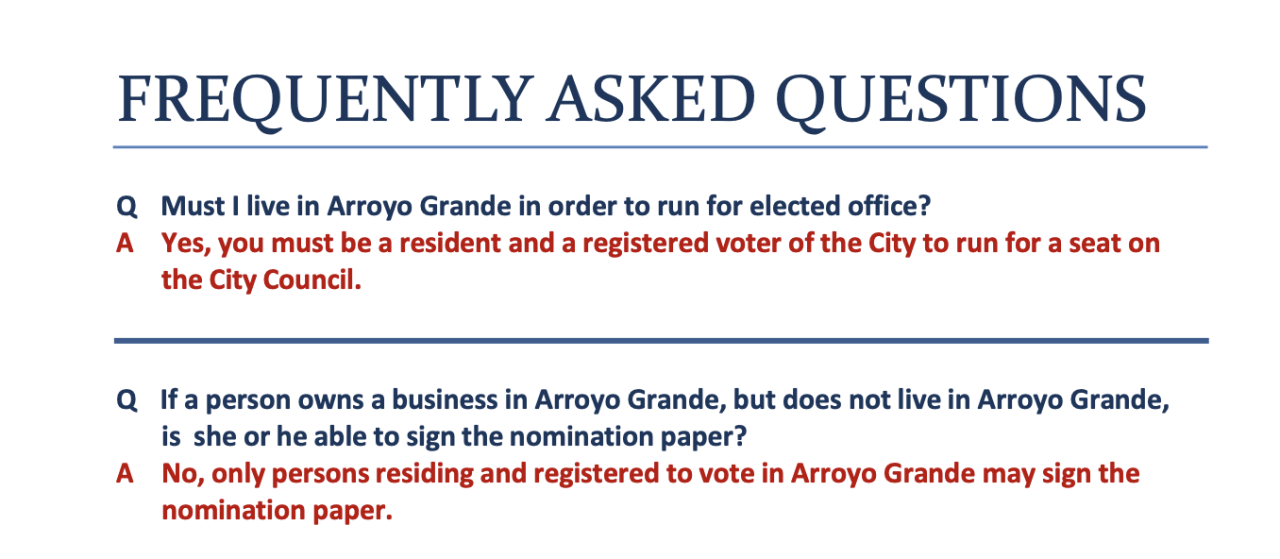
Powell also told jurors that when she decided to run for mayor, she went to a city official to ask what she needed to know before entering the race. According to Powell, the person she spoke with did not provide her with the rules regarding residency requirements or the election code, including the fact she had to reside full-time in the jurisdiction she is running for office. Instructions about residency can be found online, including at the following link in a document titled, "Running for Office in Arroyo Grande" posted by the city. The instructional document reads, "Yes, you must be a resident and a registered voter."
Prosecutors repeatedly disputed Powell's argument that they must prove intent in their rebuttal, saying Powell's claim that she made a "good faith mistake in the law" applies only if certain legal burdens are met and that those conditions do not apply in this case.
