



San Luis Obispo police motorcycle officers are stepping up enforcement against riders of high-powered electric motorcycles marketed and ridden as e-bikes but legally classified as motorcycles under California law.
Officer Nolan Parsons of the San Luis Obispo Police Department's motorcycle traffic unit said these vehicles, sometimes called "moto-bikes," are easy to spot.
"You'll know them when you see them in traffic because the riders are generally at traffic speeds as they're riding them," he said.
Bicycles that do not require pedal assist are the most obvious examples of two-wheel, single-occupant motorcycles, which can be referred to as 'e-bikes' but in fact are actual motorcycles and may not be ridden by anyone without a motorcycle license, under a certain age, in a bike lane, or on a sidewalk.

These vehicles can reach speeds of up to 75 miles per hour, far exceeding the legal limits for e-bikes in California. Several are already on the department's radar.
Parsons said certain brands are showing up repeatedly on local streets.
"There are off-road electric motorcycles in general that all follow a similar recipe; a lot of those are like your Surron brand, your Talaria brand," he said.
KSBY reviewed the Surron brand's own website, which describes its product as "easy to maneuver like a bicycle, with the torque and power of an off-road motorcycle."

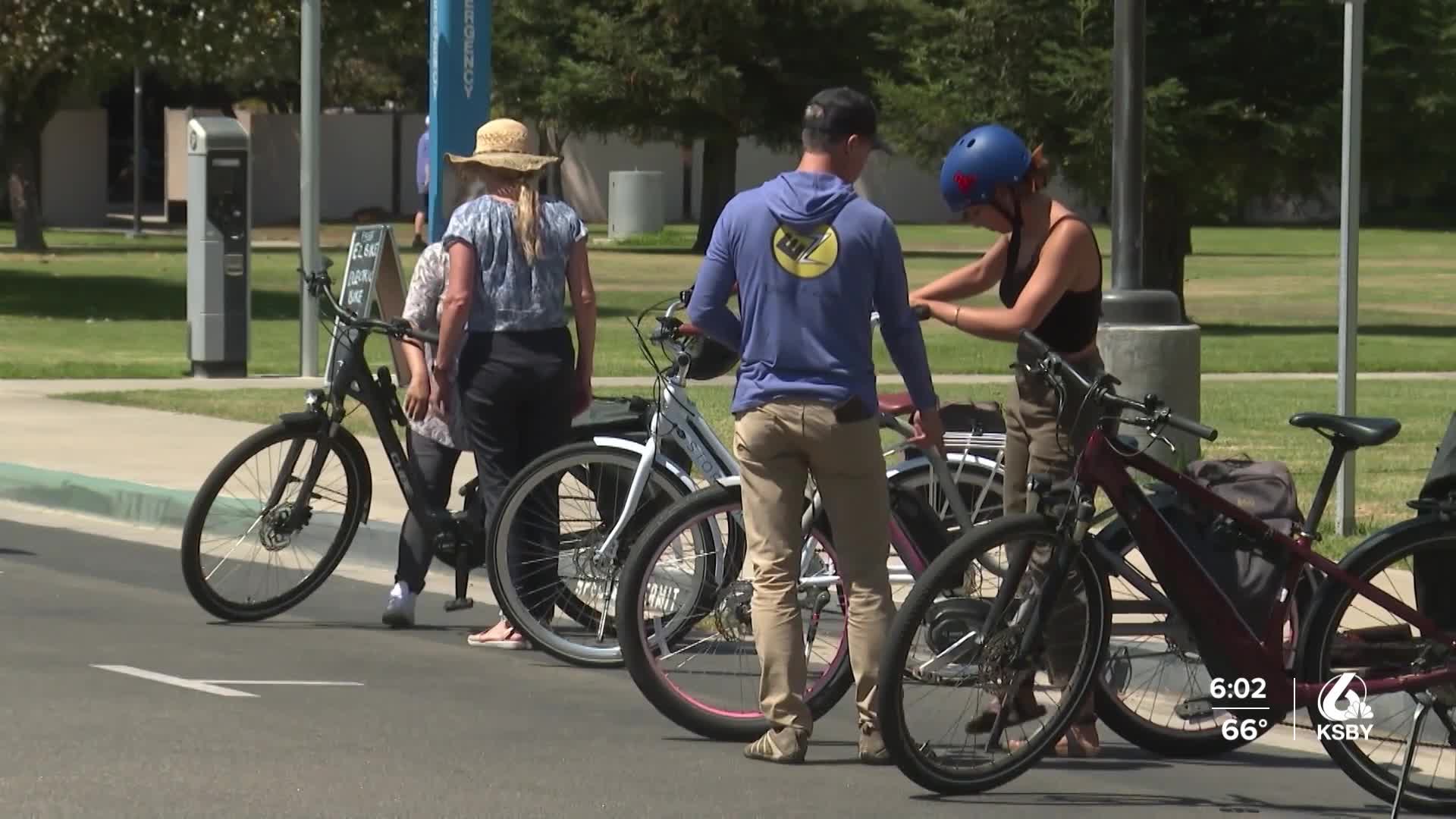
KSBY Community Reporter Jessica Roe provided the image below for perspective on what an average e-bike looks like, given they are large, about 40-50 lbs, and must not be more than 750 watts. Riders must wear a helmet and may only have an earbud in one ear for communication or music.

Under California law, legal e-bikes fall into three classes. Class 1 bikes are pedal-assist only, with a top assisted speed of 20 mph. Class 2 bikes can use a throttle or pedal-assist, also capped at 20 mph. Class 3 bikes are pedal-assist only, with a top assisted speed of 28 mph.
All legal e-bikes must have fully operable pedals and a motor of 750 watts or less. No license, registration, or insurance is required, as long as the bike stays within those legal limits.
The key distinction between a legal e-bike and a motorcycle, Parsons said, comes down to one clear sign.
"The ones you can pretty much tell are not legal for the roadways are the ones that have no pedals; they have pegs; there is no human propulsion happening."

Vehicles that exceed 28 mph with pedal assistance, or 20 mph with throttle assistance, are classified as mopeds or motorcycles under California law and require an M1 motorcycle license, DMV registration, and vehicle insurance to operate legally.
The issue is compounded when these vehicles are in the hands of riders who have never been through driver's education. E-bike and e-motorcycle crash injuries increased 430% over the last four years in Southern California alone, according to Orange County District Attorney Todd Spitzer. A UC San Diego study found injuries among e-bike riders under 18 soared 300% from 2019 to 2023.
Ben Walter, a San Luis Obispo County resident who uses a legal e-bike for delivery work, said the lack of experience among younger riders is a real concern.
"I remember being a kid and having a good time, and doing my best to have a good time without hurting anybody, but when you do not have that sense of experience and sense of caution, in the back of your head, it can be hard to account for those things."

Walter said he has little patience for riders who ignore the rules.
"It's when you see people just flagrantly breaking the rules that I find deeply frustrating," he said.
Parsons said officers are not looking to cite every rider, but dangerous behavior will be met with stronger action.
"When we find the other riders who are on the back tire, who are ripping through traffic, blowing a stop sign, weaving between cars, going the wrong way through oncoming traffic, they're not going to get quite as much courtesy, and we're going to default to stronger enforcement at that point because it's obvious we need to keep them safe, and the public safe," he said.
California has been tightening its e-bike laws. Senate Bill 1271, which took effect Jan. 1, 2025, capped motors at 750 watts, required UL-certified batteries by Jan. 1, 2026, and banned throttles on Class 1 and Class 3 e-bikes. Assembly Bill 1774, signed July 2, 2024, banned the sale and use of aftermarket speed-modification kits that push e-bikes past legal speed or wattage limits.
Under SB 1271, schools and police can confiscate non-compliant e-bikes, and parents can be cited and fined for their minor child's e-bike violations.
Helmet rules also apply. All riders on Class 3 e-bikes must wear a helmet. Riders under 18 on Class 1 or Class 2 e-bikes are also required to wear helmets.
If you have a story idea you would like to send to KSBY Community Reporter Jessica Roe, you can reach her directly via email at jessica.roe@ksby.com.
