

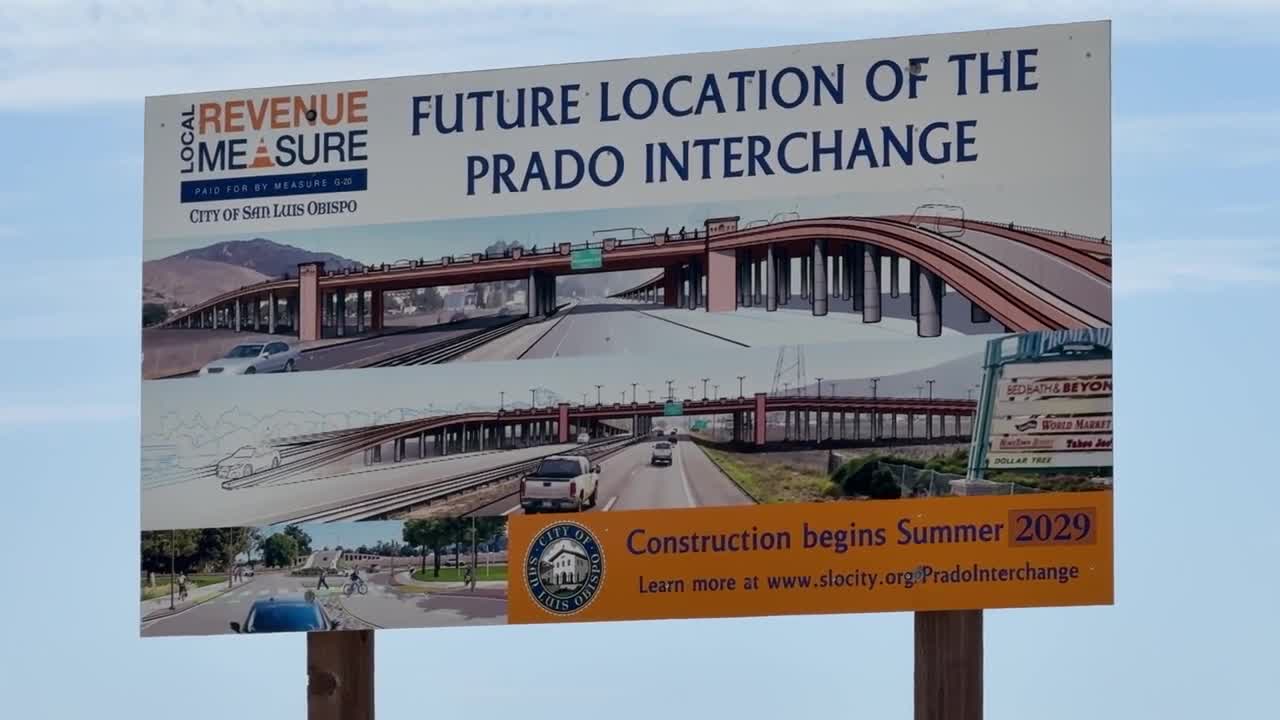


The long-awaited Prado Road interchange in San Luis Obispo is moving forward, with the city council approving pre-construction work this week and a timeline now in place for the overpass to be built.
The project is part of a broader investment in the city's infrastructure.
"These projects represent about a $200 million investment in our community," said Matt Horn, San Luis Obispo Major Projects Manager.
Horn said the investment will bring jobs locally and fill hotel rooms nearby, with expenses going back into the San Luis Obispo economy.

On Tuesday, the city council gave Horn's team the go-ahead to begin pre-work on the project. That phase includes widening the Prado Bridge at Higuera Street to reinforce it and add pedestrian and bicycle access, ensuring a safe route from Higuera all the way over to Dalidio Drive.
The pre-work is expected to be completed before the main overpass construction begins in 2029.
"There's actually probably a team of 30 different people working on this project and doing different design elements to it," Horn said.
The interchange is classified as a partial interchange, meaning only one side of the freeway will have on and off ramp access when the project is completed by 2031.
"It's classified as a partial interchange, and so that means the one side of the freeway will have access like it does right now. The other side will not," Horn said.

The eastern side, which currently has an on- and off-ramp, is the side that will retain highway access.
Once complete, the interchange will provide a crossover connection in the middle of town, eliminating the need to travel north to Madonna Road or south to Los Osos Valley Road to cross Highway 101.
Residents like Elaine Maxwell are looking forward to the change.
"I think it'll be great once it's opened!" Maxwell said.
She acknowledged that the project has required patience from the community.
"I know things take time, so we just have to learn to be patient," Maxwell said.
Horn noted that a full interchange remains a possibility down the road, though cost and existing surrounding facilities are currently the primary barriers.
"At a future date, it's still a possibility. We didn't want to preclude that from happening in the future. The barriers that are kind of stopping us right now from implementing those things are one, cost driving up the project cost, and then secondarily, it's the existing facilities surrounding this project," Horn said.
If you have a story idea you would like to send to KSBY Reporter Jessica Roe, you can reach her directly via email at jessica.roe@ksby.com.
