

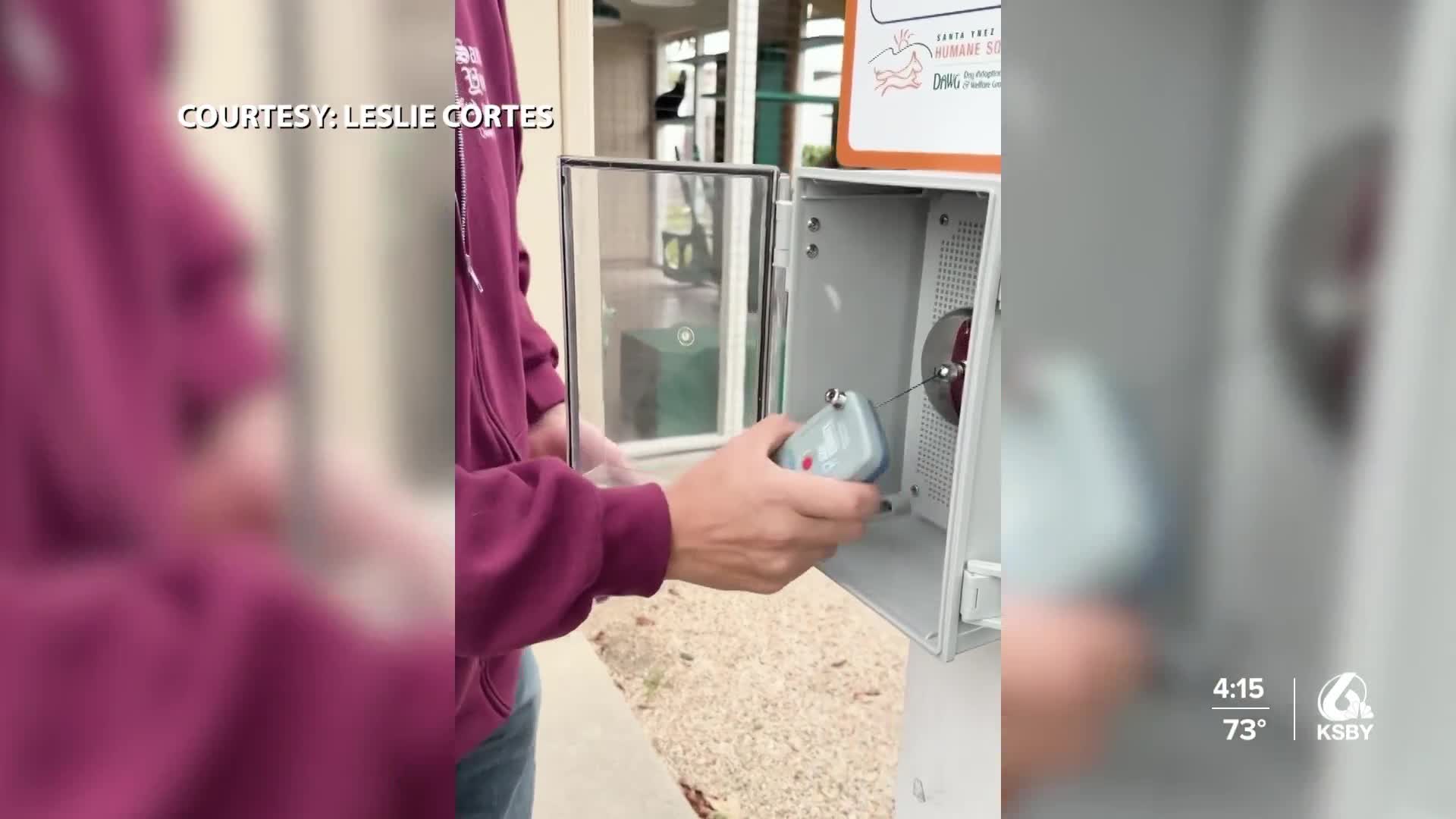



When Kim Knowlton arrived at PAWS Park in Buellton with her three dogs, something near the entrance immediately caught her attention: a public pet microchip scanner.
Knowlton, who was visiting from Henderson, Nevada, said all three of her dogs are microchipped, but she had never seen a public scanning station like the one in Buellton.
“I took pictures of it. I was so amazed,” Knowlton said, adding that she thought the station was easy to spot and understand.
The station at PAWS Park is one of five installed around Buellton as part of an effort to give people another option when they find a lost pet.
Instead of waiting for a veterinarian, shelter or other organization to open, someone who finds an animal can use one of the scanners to check for a microchip and begin the process of locating its owner.
For Knowlton, having that option readily available makes sense. She said if she encountered a dog wandering alone and could safely approach it, she would use one of the scanners to try to help.
Buellton Vice Mayor Carla Mead, who also serves on the board of the Santa Ynez Valley Humane Society, was involved in bringing the scanners to the city.
Mead said the idea was to make it easier for people who find lost animals to do the right thing without necessarily having to drive to Santa Barbara County Animal Services, which she said is about 20 minutes away.
“Having these microchip stations basically makes it easy for people to do the right thing and try to get lost pets reconnected with their owners,” Mead said.
Mead said the scanners were provided to the city and Buellton’s Public Works Department installed them at five locations. She said officials intentionally selected places where someone who finds a lost animal might naturally go, including PAWS Park and the Santa Ynez Valley Humane Society.
A few months after the scanners went up, however, determining exactly how often they’re being used and how many pets they’ve helped reunite isn’t necessarily straightforward.
Dr. Shana Schank, Executive Director of the Santa Ynez Valley Humane Society and Dog Adoption & Welfare Group, said she has not personally heard of a major reunion directly attributed to one of the new public scanners.
What she has noticed is increased awareness.
“We have seen more of an increase in people just being aware of the use of microchip scanners,” Schank said. She said more people are also learning how to use the devices and coming in to have their own pets microchipped.
Mead said she’s also seeing evidence of that awareness online. On local social media pages, she said residents regularly remind each other about the public scanners when someone posts about a missing animal, particularly when other services are closed.
But scanning an animal is only the first step.
Schank said using the scanner itself is relatively intuitive. Once a chip is detected, however, the owner’s information does not simply appear on the device. The microchip number must be looked up to continue the reunification process, something she said can be a hurdle for members of the public unfamiliar with how the system works.
Mead said the process also protects pet owners’ personal information. The person scanning the animal receives the microchip number rather than the owner’s phone number or other personal details. The microchip registry can then use the number to contact the registered owner.
That makes keeping a pet’s microchip registration current especially important.
For Schank, one of the biggest benefits of the public stations is their round-the-clock availability.
“If they can get that information overnight or when we are not available, then they can potentially find the owners much faster,” Schank said.
Still, Schank said the Humane Society has not noticed a decrease in the number of lost pets it sees. She described addressing the issue as an “uphill battle” and said continuing to encourage pet owners to microchip their animals remains important.
Mead said she would like to see the program build on its educational component, including more information explaining how microchips and the scanners work. She also said she would eventually like to see additional scanners available to the community.
For Melton, the value of microchipping comes down to having another safeguard if a pet gets loose.
“It’s peace of mind,” Melton said, explaining that a pet can slip through a door or gate and may not always have its collar when someone finds it.
“You just can’t depend on the collar all the time,” she said.
Schank recommends residents familiarize themselves with the public stations before they need one, particularly people who frequently walk or bike around the community and may encounter a loose animal.
“The faster you can do it, the quicker you reunite that animal,” Schank said.


