

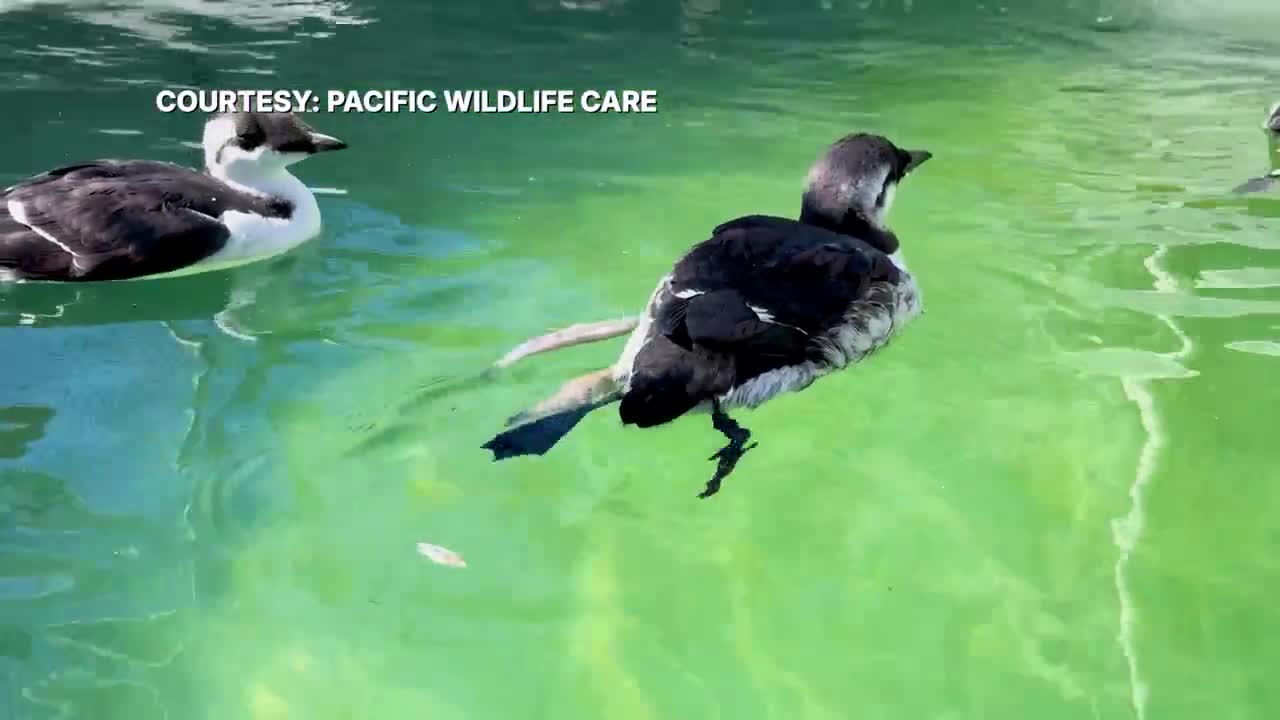


Officials at Pacific Wildlife Care, which cares for injured, oiled or emaciated birds, say they've recently been treating more seabirds.
“Right now we are dealing with an influx of common murres and this is a very unusual influx,” said Kelley Boland, Pacific Wildlife Care Development Coordinator.
Common murres are seabirds that spend most of their life out on the water. Boland said Pacific Wildlife Care has taken in more than 200 common murres since Sept. 1, with most arriving within the last 10 days.
“We had a record 26 common murres admitted in one day, which is a record for common murre admissions for our clinic in our clinic's history,” Boland said.
Boland says many of the birds arrive weak and malnourished, suggesting a starvation event likely caused by changing water temperatures along the coast.
“Warm water will drive prey fish that generally like cooler water deeper into the colder water and out of reach for these seabirds that hunt fish,” Boland said.
The California Department of Fish and Wildlife said that the bulk of these reports have been in San Luis Obispo, Monterey, Santa Cruz and San Mateo counties.
In a statement, Fish and Wildlife said the agency’s wildlife health lab is receiving its first batch of birds this week for postmortem examinations, and findings on the possible causes of death are not yet available. Officials are also asking the public not to touch or handle dead, sick, or injured seabirds, and instead report them to a local wildlife rehabilitation facility.
“We start by making sure that they’re stable, so by taking their temperature," said Sophie Swan, Pacific Wildlife Care Rehabilitation Technician. "A lot of them arrive very cold. It’s been a very long, painful journey coming from offshore to the beach.”
After the birds are warmed up, staff will perform tests such as blood work and swabs to evaluate their health.
The birds will first be monitored and fed inside before being moved outside ahead of their release back into the wild.
Swan said many of the birds have been found tangled around kelp on the beach.
“If you happen to be walking the beach and you walk past a big pile of kelp, if you wouldn’t mind just checking to see that there’s no birds that kind of look like a penguin, that would be great. If you do see one that’s alive, they definitely need to be brought in. They won’t survive on land," Swan said.
Pacific Wildlife Care has a hotline you can call to report birds at (805) 543-9453.
