

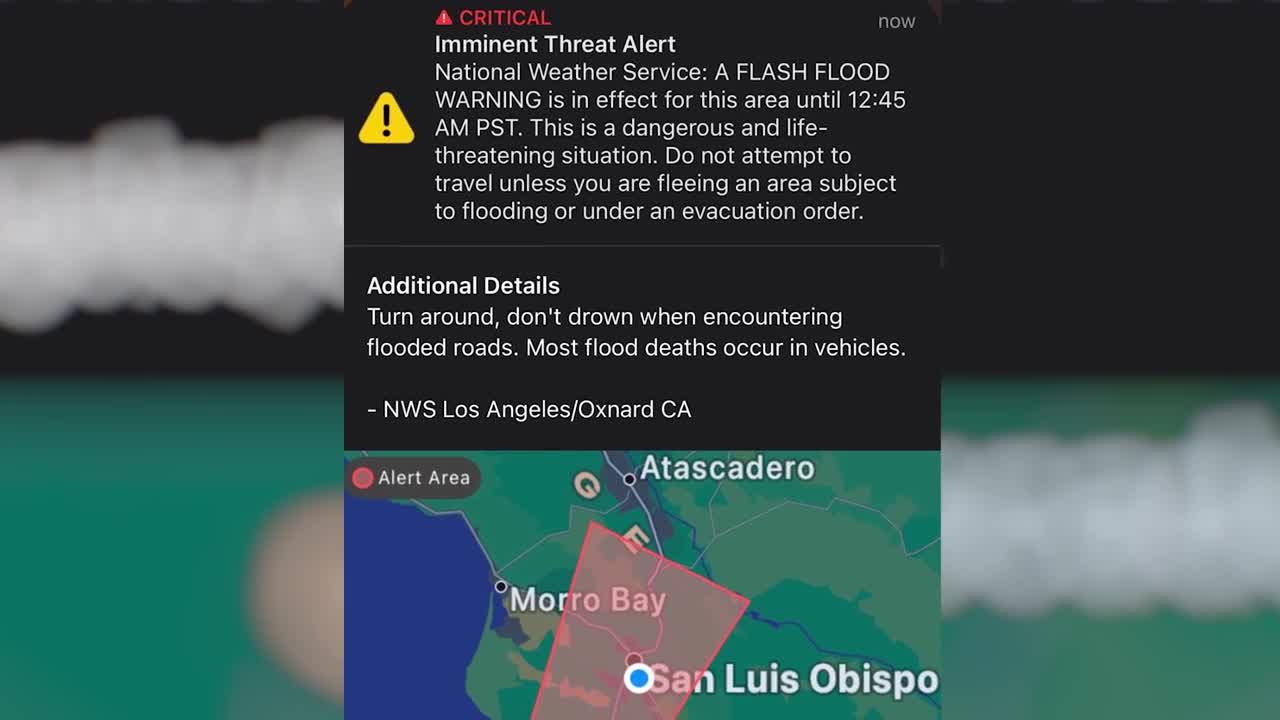


Some people on the Central Coast saw flash flood warnings pop up on their phones during the latest storm. And with the threat of El Niño over the coming months, more could follow.
KSBY News looked into what triggers these alerts and how officials determine who gets one.
Early Thursday morning, a piercing sound may have jolted you awake: a flash flood warning. That unmistakable alert means one thing: pay attention.
Parts of the Central Coast were suddenly facing dangerous flooding conditions.
“The way the storm was structured, it brought us inches of rain to the Central Coast in a short amount of time,” said KSBY Daybreak meteorologist Vivian Rennie. “About two inches of rainfall fell in less than an hour. Those rates, the ground just can’t handle, so that’s where we saw lots of alerts, watches, warnings and advisories.”
What started out as a flood advisory got a strong shove into a flood warning when rain gauges and automated radar sites picked up that it had rained over an inch in that very short amount of time.
So, what do you do when your phone sounds the alarm?
“The best thing to do is to stay put,” Rennie said. “If you are already in a vehicle, find somewhere safe; make sure you are at a place where you are already safe. If you happen to be in an area that is actively flooding, that is the time where you do need to keep on going and kind of get out of that immediate danger, and you want to do that as quickly as possible.”
And if you never got one, there’s a reason. Rennie says it’s because the warnings essentially followed the direction of the storm.
“As that core of the cold front continued to progress down to the south, that’s where we saw those other alerts kind of pop in,” she said. “So you have another alert that covered most of the Five Cities, a secondary alert and a tertiary alert that covered Santa Maria and much of the Santa Ynez as that storm came down and farther south.”
But that startling sound on your phone was just the end of a much bigger process.
Before an alert ever reaches your screen, forecasters are watching the storm and determining whether conditions have become dangerous enough to warrant a warning.
“We’re looking at a lot of things,” National Weather Service morning coordination meteorologist Todd Hall. “We’re looking between satellite, radar data, looking at what the atmosphere is doing at that time, from our training as meteorologists… is it entering an area where there’s more lift in the atmosphere? Less lift in the atmosphere? Is it an area where we could see there could be colder temperatures aloft, where it can enhance some storms?”
Then comes the other side of the equation: making sure the warning reaches you.
“If you have weather WEAs [Wireless Emergency Alerts] enabled on your phone for any flash flood warnings or severe thunderstorm warnings, or tornado warnings, that will go off,” Hall said. “Some people don’t know they have that setting; some people don’t know they can turn that setting on or turn that setting on.”
Because whether it wakes you from a dead sleep or catches you on the road, that jarring sound is there for a reason: to give you time to get out of harm’s way.
